The other day, I created a page compiling a series of recommended books for senior psychiatry residents by Dr. Irito Akiisa [1]https://twitter.com/pppsychiatryyy.
[Psychiatry Journal Club] A LINE journal club for exchanging information on psychiatry-related papers, seminars, and more. Started last year, it now has over 200 members regardless of university affiliation or experience. Since the new fiscal year just began, members are currently sharing information on textbooks that residents should read. Many thanks to @LINE_Global OpenChat. Please DM me if you are interested.
— Shin Luke Nakaji / Shinichiro Nakajima (@Luke_629) April 12, 2021
I handled the data wrangling and visualization using R. Please see the results below.
Survey details
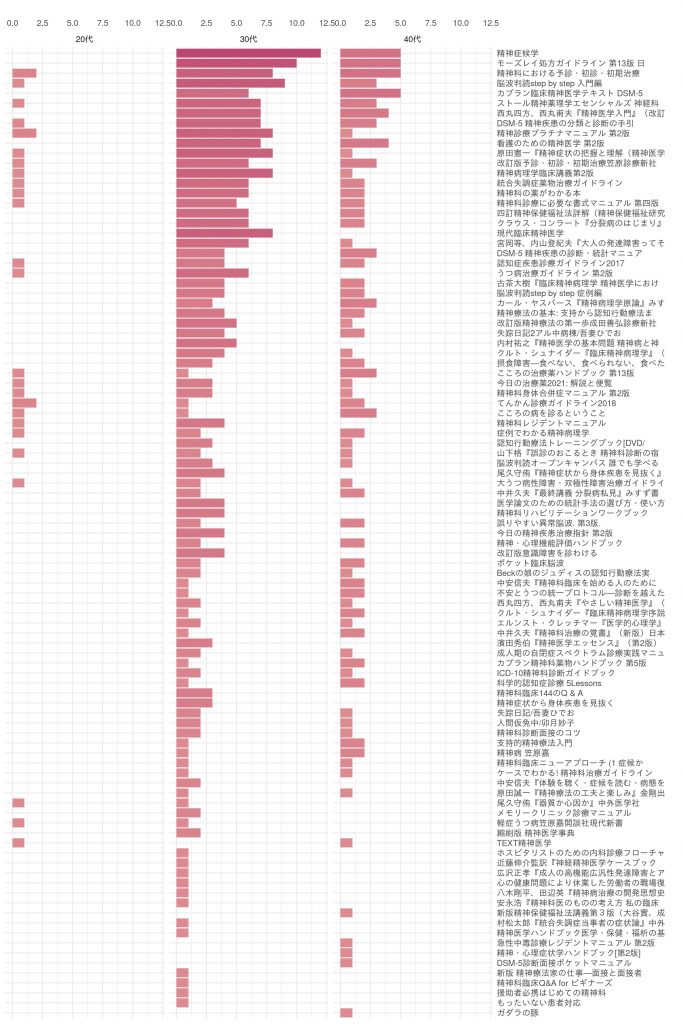
You can view the survey here. I will analyze three items: a single-choice question for age group, a multiple-choice question for recommended books, and an open-ended question for other recommended books.
R code
Please see below for the R code used in this analysis.
This document was created in an R Notebook. You can download the code from the CODE button in the upper right.
The code itself includes some complex operations. I have added notes throughout to make it as easy to read as possible and explain what each step does. Even if you are looking at R code for the first time, I hope it sparks your interest in how these operations work.
To start learning R, I recommend this book, whose revised second edition came out in May 2021: Yuya Matsumura, Hiroaki Yutani, Yasunori Kinosada, and Kazuhiro Maeda. 改訂2版 RユーザのためのRStudio[実践]入門〜tidyverseによるモダンな分析フローの世界 [Practical Introduction to RStudio for R Users, Revised 2nd Edition: The World of Modern Analytical Workflows with tidyverse]. Gijutsu-Hyohron; 2021. https://www.amazon.co.jp/dp/B095W5G8KB
The pilot version of the analysis code used before publishing this version can also be viewed here.
Results
Clicking on a book title will run a Google search for it. All tables and figures were created in R. If you would like to download them as PDFs, please use the download buttons provided for each.
Number of respondents
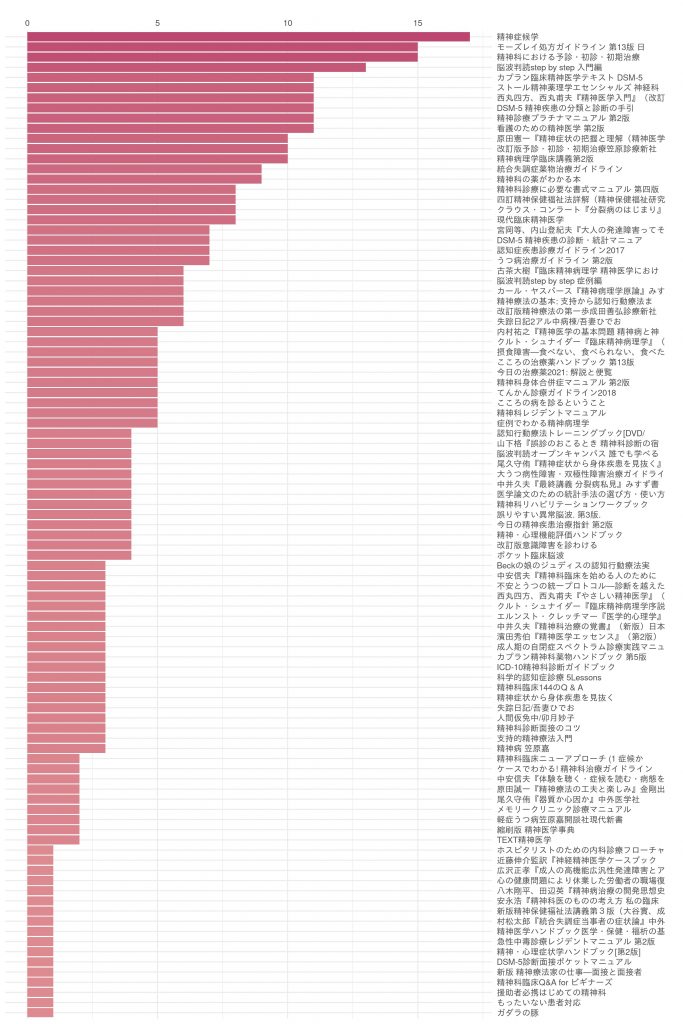
A total of 31 psychiatrists responded. Out of 117 books, the median number of recommended books selected per respondent across all age groups was 14.
*Psychiatric Symptomatology* (*Seishin Shokogaku*), which received the most votes, was also recommended by Dr. Akiisa Irito.
*Psychiatric Symptomatology* by Hidenori Hamada I use it like a dictionary of psychopathology. Wanting to use accurate terminology as early on as possible, I consulted it extensively. #PsychiatryFellowshipBooks
— Akiisa Irito @ Psychiatry (@pppsychiatryyy) March 10, 2021
It describes each symptom in detail and is very informative. Understanding the correct terminology is essential when discussing cases with colleagues. It makes complete sense that so many people chose to recommend it.
"Blunted affect accompanied by abulia is called emotional and volitional blunting, and when severe, emotional deterioration. In the early stages of schizophrenia, impulse control fails, often causing emotional instability such as sudden dejection, heightened sensitivity moved by trivial matters, and irritability. Subsequently, patients complain of a subjective sense of alienation, and blunted affect becomes objectively evident." https://t.co/2RO7nn2V0E
"Hypobulia is a decrease in drive and a decline in initiative, leading to frequent hesitation, difficulty making decisions, and reduced activity or psychomotor retardation. Patients complain of 'feeling unmotivated,' 'lacking stamina,' or 'my body won't keep up even when I try,' and in extreme cases, it leads to stupor." https://t.co/2RO7nn2V0E
The book list originally used for the survey consisted of the 117 books below (!). The doctors in the LINE and Slack groups mentioned above helped select each of these books, and Dr. Kazu compiled the list.
Below is a list of the 20 books that have not yet appeared in the lists above. If you want the full list of all 117 books, please download the PDF below.
Thank you for reading to the end. A huge thank you to Dr. Kazu for all his hard work on this project. Please also check out this article compiling reference books recommended by Dr. Akiisa Irito.