Using generative AI to prepare grant applications
Contents
- Introduction
- Three steps to preparing an application: Ideation, analysis, and structuring
- The essence lies in ideation
- Tasks to delegate to generative AI in grant preparation
- Two AI agents: Divergence and convergence
- Agent-A: Divergence support (gathering material)
- Agent-B: Convergence support (analyzing literature)
- Moving back and forth between the agents
- Ethical considerations
- Summary
- Agent links
- Related
Introduction
Writing grant applications is an unavoidable task for researchers. Yet when we look back at why proposals get rejected, the problem often lies in how they are written rather than in the research idea itself. Reviewers are busy and reportedly spend about 10 to 15 minutes evaluating each application. Even a strong idea will not earn a high score if it fails to get across to the reviewer. The quality of an application is decided at the stage where you figure out how to communicate your idea.
This article introduces a way to expand your research ideas and deepen your analysis before writing a grant application, using principles from design thinking and two AI agents (Agent-A and Agent-B). The key is to use generative AI for your own thinking process, rather than having it write the proposal for you.
Three steps to preparing an application: Ideation, analysis, and structuring
The quality of a grant application depends on the preparation done before writing begins. I view this preparation in three steps: ideation → analysis → structuring.
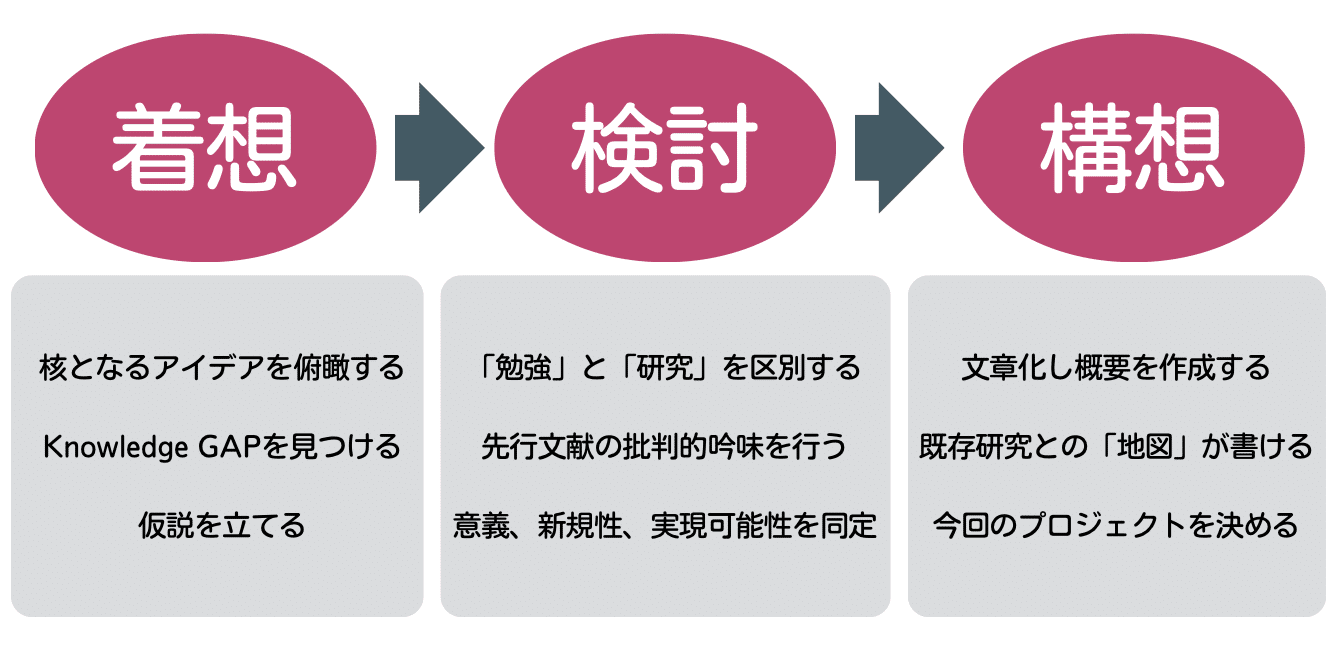
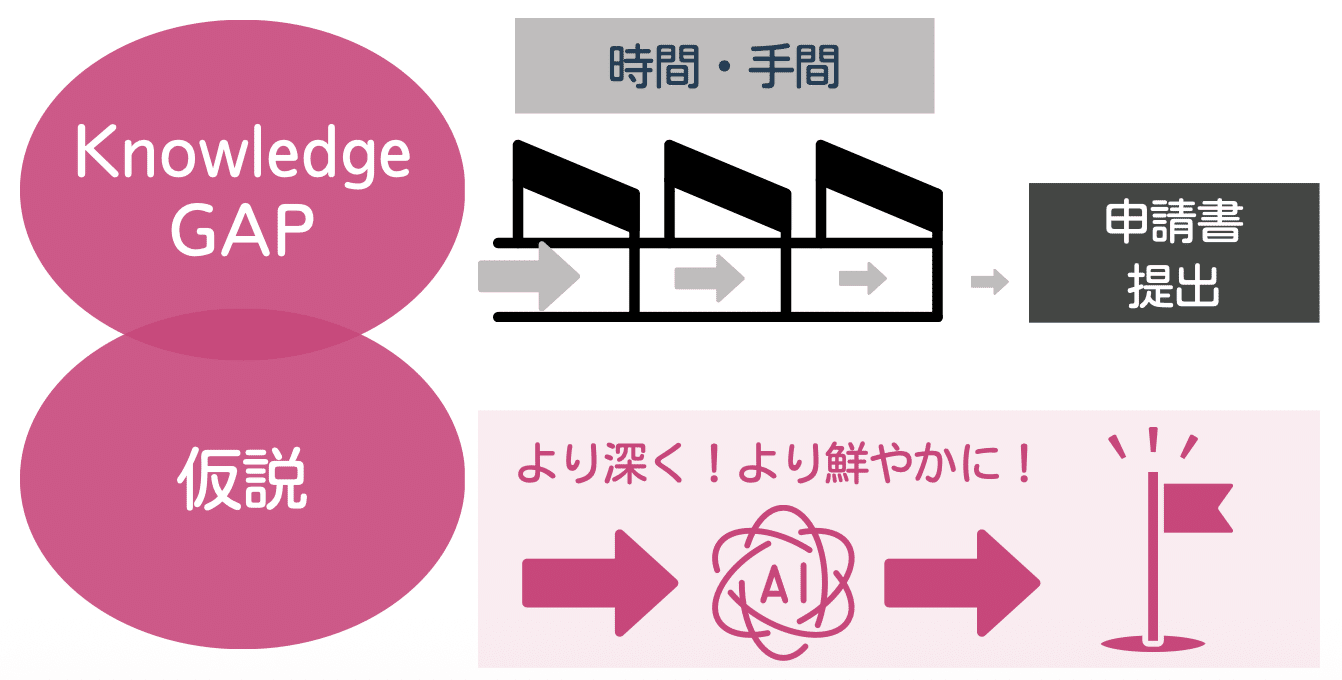
In ideation, you survey your core idea, identify the Knowledge GAP (what remains unknown), and formulate a hypothesis. This is the most important step; the quality of your initial idea largely determines whether the application gets funded.
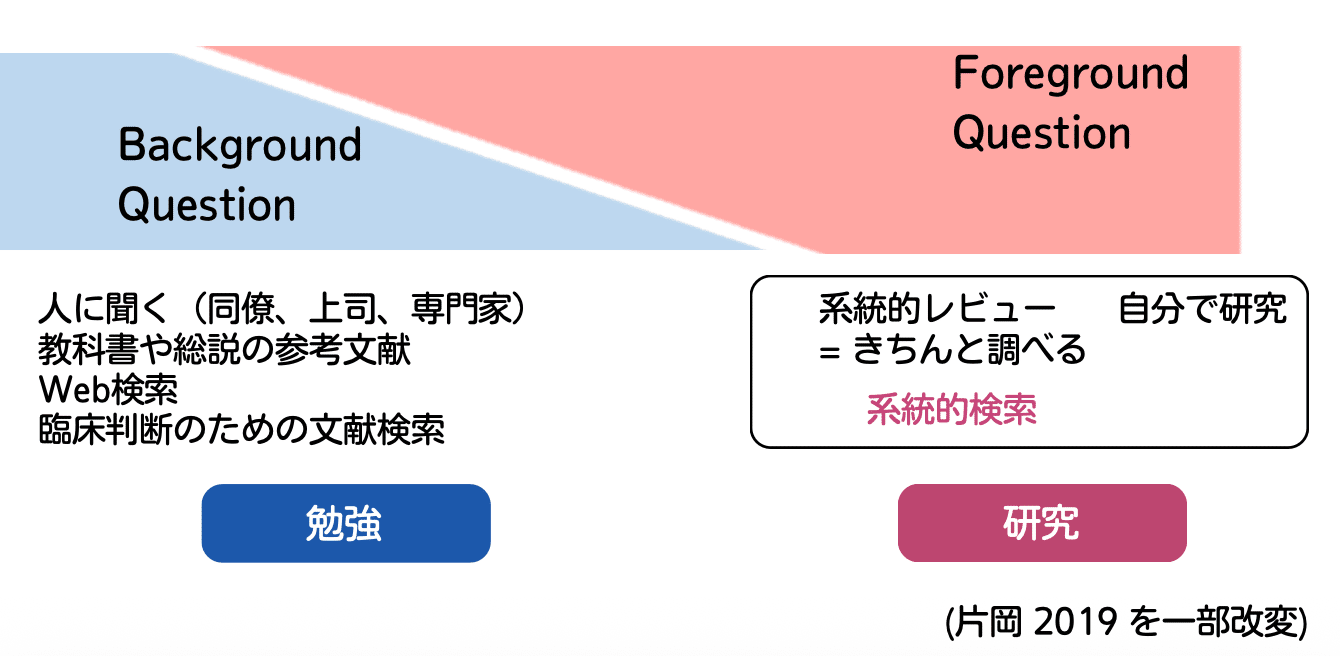
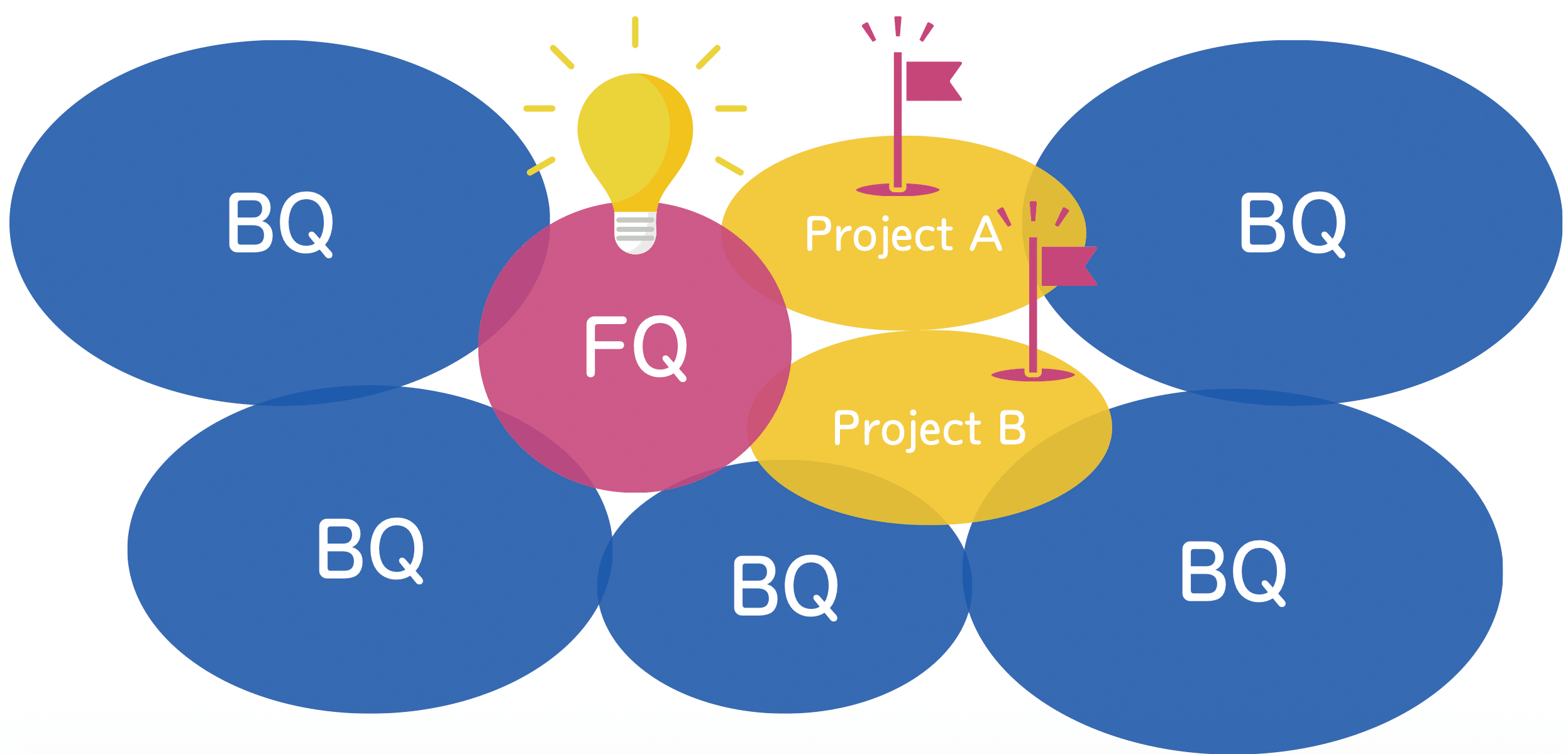
In analysis, you distinguish between "studying" and "research." You separate Background Questions (BQs), which can be answered through textbooks and review articles, from Foreground Questions (FQs), which you must answer through your own research. Investigating the answers to BQs brings your FQs into sharper focus. This is also the stage where you critically appraise prior literature and verify the significance, novelty, and feasibility of your project.
In structuring, you put your thoughts into words and draft an outline. You map out the relationship to existing research and clarify where your project fits in.
Working carefully through these three steps leads to a stronger application.
The essence lies in ideation
Generative AI is most useful in grant preparation when cutting down the time spent on tedious tasks. Still, we must not forget that whether a proposal succeeds depends on the underlying idea.
If you feed scattered notes directly into an AI, its output will remain vague. Organizing your core idea and how your related thoughts connect before entering a prompt significantly improves the response. The quality of the input determines the quality of the AI's output.
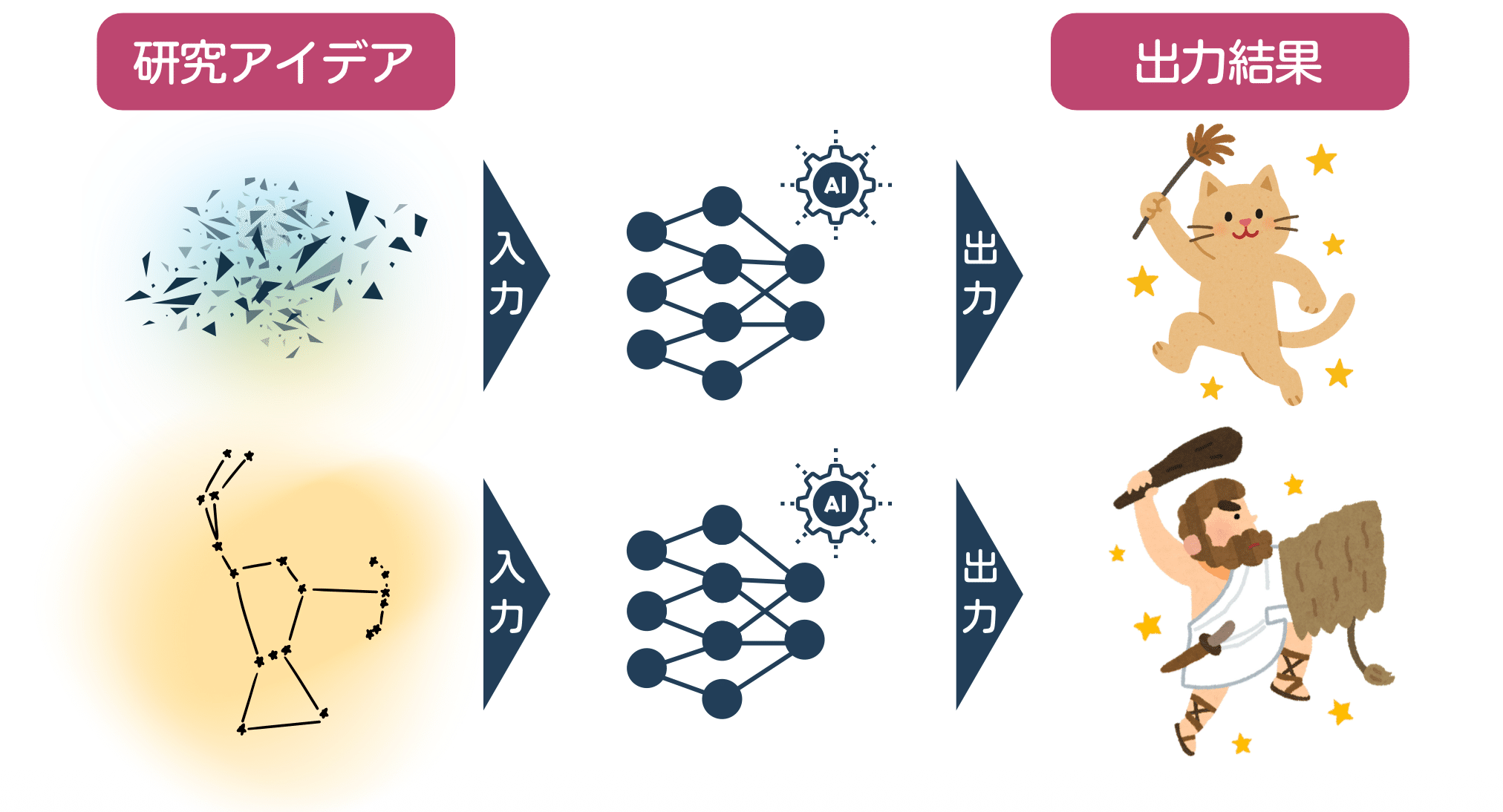
You can use generative AI at each stage—ideation, analysis, and structuring—to deepen your thinking and make your plan more concrete. Using AI does not mean you can skip ideation or analysis.
Tasks to delegate to generative AI in grant preparation
When using generative AI to prepare grant applications, it helps to keep three roles in mind.
Reduce the effort of looking things up. Summarize literature, extract key arguments, build comparison tables, and spot gaps in logic.
Broaden your thinking. Generate numerous questions and identify counterarguments or alternative approaches.
Pull your thoughts together. Draft headings, summarize paragraphs, and make phrasing more concrete.
Any numbers or citation sources provided by an AI are merely information derived from its training data. You must always check the original sources.
Generative AI tools with web search capabilities (such as ChatGPT, Claude, and Gemini) use Retrieval-Augmented Generation (RAG) to quickly find answers to BQs. This is especially useful when gathering background knowledge.
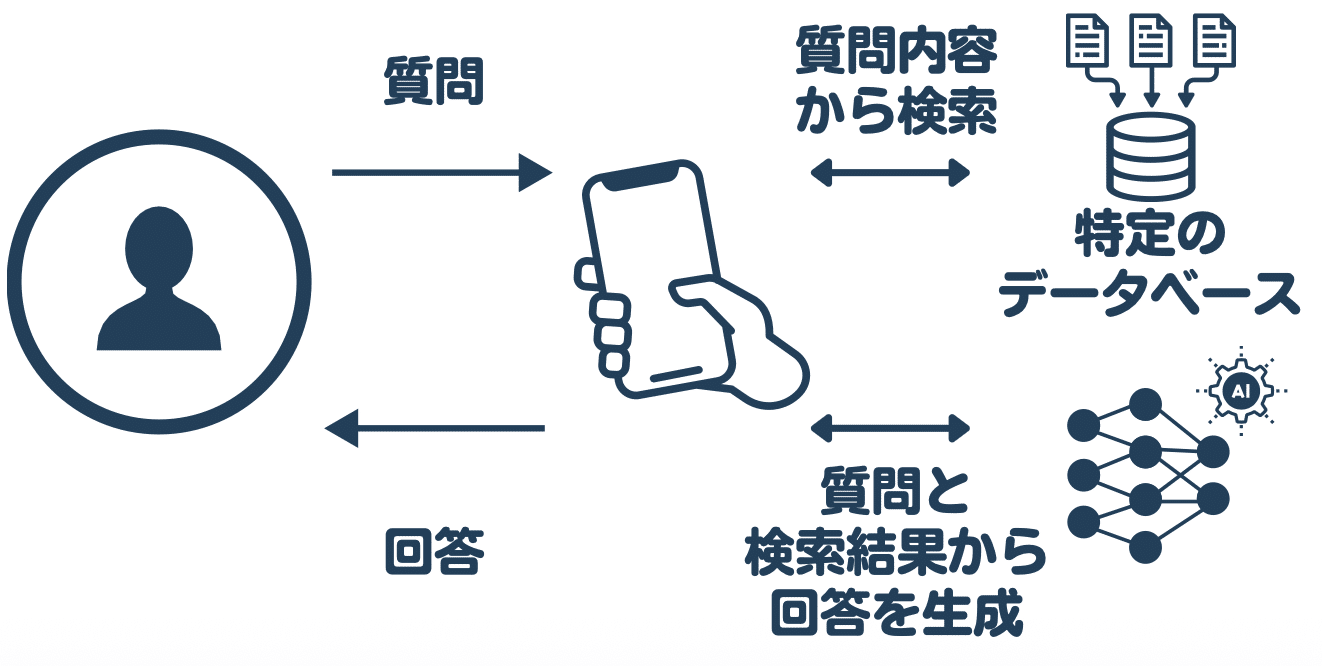
Two AI agents: Divergence and convergence
Here I introduce two AI agents that correspond to "divergence" and "convergence" in design thinking. Both are available for free.
Agent-A: Divergence support (gathering material)
Use this agent at the material-gathering stage before you start writing the application. In the three steps of grant preparation, it corresponds to the ideation phase.
Input: Notes on your research theme or rough jottings on the problems you want to address
Process: Three personas (Explorer, Verifier, and Designer) develop a discussion.
Explorer: Organizes the importance of the theme and proposes an overall structure
Verifier: Searches prior research and examines its strengths and limitations
Designer: Organizes the Knowledge Gap and turns it into a tractable research question
Each persona screens the literature, selecting high-quality papers from a pool of 30 to 50 candidates.
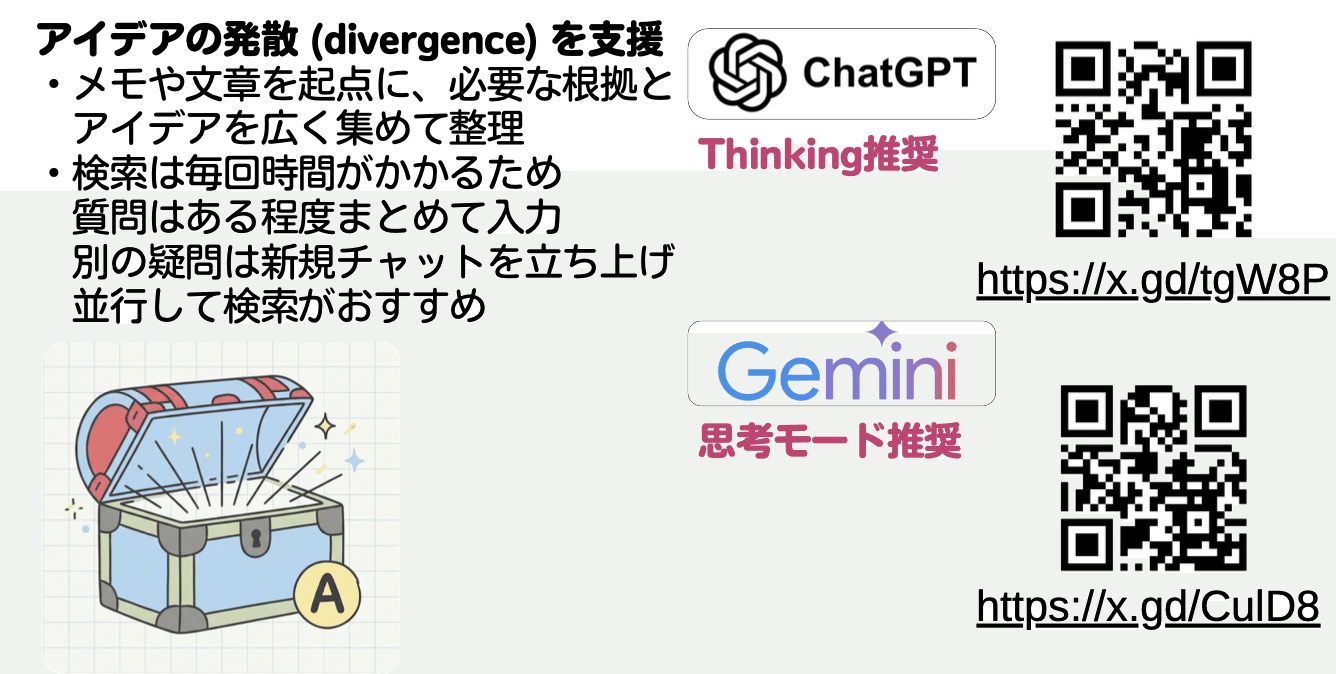
Try Agent-A
ChatGPT GPTs:x.gd/tgW8P
Google Gemini Gem:x.gd/CulD8
Agent-B: Convergence support (analyzing literature)
This agent organizes the literature gathered with Agent-A into a form you can use in your application. In the three steps of grant preparation, it corresponds to the analysis phase.
Input: A PDF or URL of a paper
Output: A structured summary. Specifically, it organizes the following as points you can use in your application:
Passages that provide background material
Passages useful as methodological references
Identified research gaps
Sample phrasing for citations
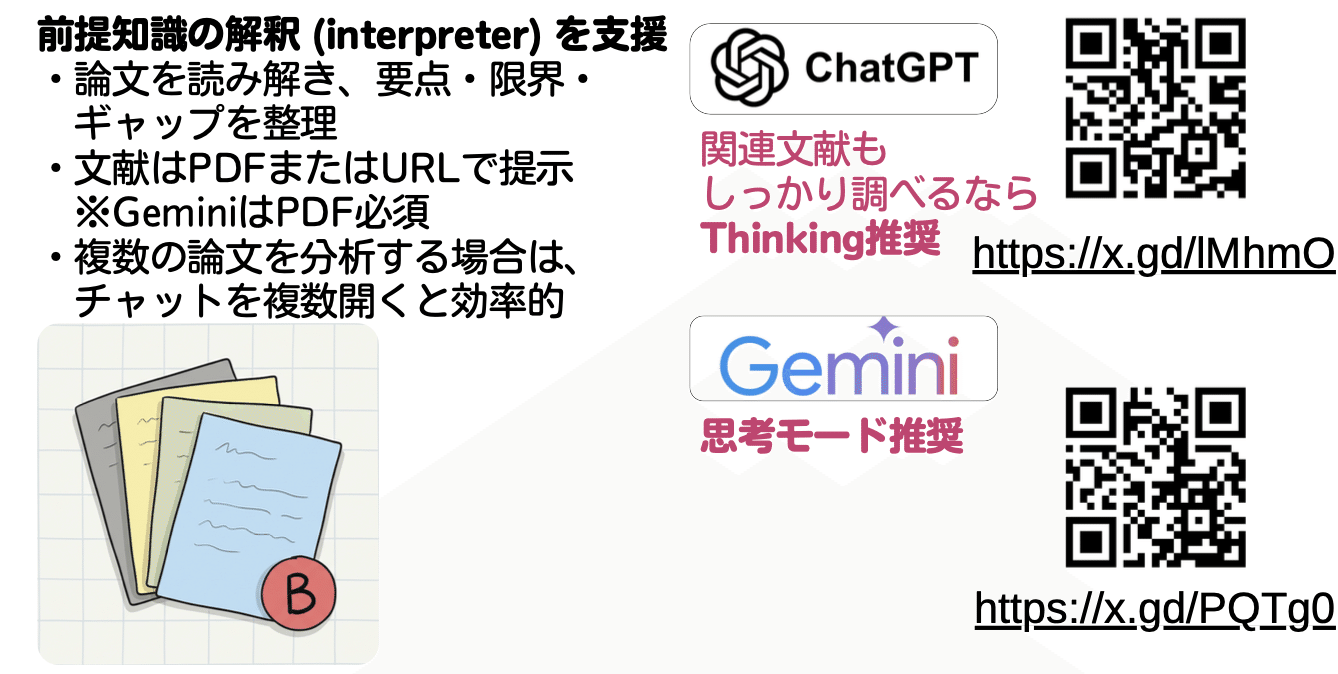
Try Agent-B
ChatGPT GPTs:x.gd/lMhmO
Google Gemini Gem: x.gd/PQTg0 (*Note: Gemini currently does not work well with URL-only inputs, so please enter a PDF or text instead.)
Moving back and forth between the agents
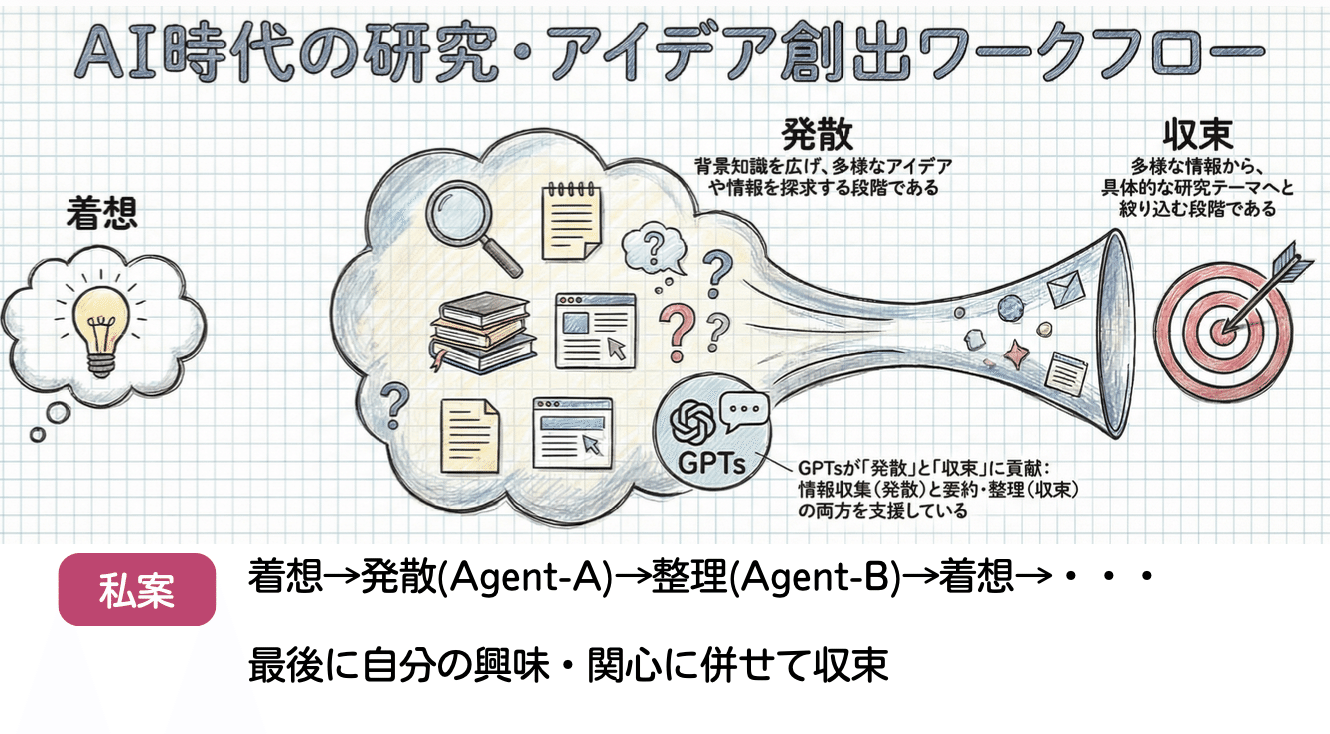
You do not need to use the two agents in a strict linear order from A to B.
For example, if you spot a new gap while analyzing a paper with Agent-B, you can return to Agent-A to gather fresh material. If you want to understand a paper surfaced by Agent-A in greater depth, you can generate a detailed breakdown with Agent-B. Being able to move freely back and forth like this is the advantage of designing them as separate agents.
By repeating divergence and convergence multiple times, you can refine your ideas while clarifying both the Knowledge GAP and your hypothesis.
Ethical considerations
When using generative AI to prepare grant applications, several points require caution.
Confidential and personal information: Anonymizing input data is essential. Take care never to enter personal information related to your research into an AI.
Guarding against hallucinations: Make it a habit to verify all AI-generated information against the original sources. As the user, you are responsible for checking the facts so you do not overlook plausible-sounding errors.
Avoiding "AI-sounding prose": Vague, overstated phrasing and text heavy with abstract modifiers give the impression of being written by AI. Aim for concrete, concise language.
NIH policy: In July 2025, the US National Institutes of Health (NIH) explicitly stated that it will not consider applications "substantially developed by AI, or containing sections substantially developed by AI" as the applicant's original ideas, and will not review them. This measure protects the fairness of the review system after instances were observed of a single PI submitting over 40 applications in a single funding cycle.
The NIH (US National Institutes of Health) explicitly stated that it will not treat "applications substantially developed by AI, or containing sections substantially developed by AI" as the applicant's original ideas, and will exclude them from review. It observed cases such as a single PI submitting over 40 proposals in one solicitation. The agency noted this places excessive strain on the review system and can undermine fairness and originality. (July 2025) pic.twitter.com/PWZ3uodZAw
— Shoei (@shoei05) January 20, 2026
Positioning of KAKENHI: Grants-in-Aid for Scientific Research (KAKENHI) support "creative and pioneering research by individual researchers." The Japan Society for the Promotion of Science (JSPS) has issued a caution regarding generative AI use, reminding applicants to watch out for the risks of copyright infringement and information leaks. https://www.jsps.go.jp/j-grantsinaid/35_kokusai/05_sendou/koubo.html
The Ministry of Education, Culture, Sports, Science and Technology (MEXT) likewise defines research activity as "creating new knowledge based on one's own reflection, thinking, and ideas." AI is strictly an auxiliary tool; the core of the research must be your own thinking.
From the KAKENHI Application Procedures (FY2026 Fund for the Promotion of Joint International Research [International Leading Research], announced January 9): "Using generative AI when preparing research proposal documents carries the risk of unintended copyright infringement and leakage of personal or confidential information. Please keep this in mind and make judgments under your own responsibility as an individual researcher." https://t.co/fUfnd8fapi pic.twitter.com/KfNZXOznum
— Shoei (@shoei05) January 31, 2026
Summary
In preparing a grant application, the quality of your initial idea matters most. When the core idea—your Knowledge GAP and hypothesis—is solid, the application naturally becomes persuasive. Generative AI can save effort across the stages of ideation, analysis, and structuring, helping you deepen your thoughts and make your plan concrete. Gather materials broadly with Agent-A (divergence support) and analyze the literature with Agent-B (convergence support). Moving back and forth between the two to repeat the divergence and convergence of design thinking will sharpen your ideas. Use AI for your own thinking process rather than as a ghostwriter. Final judgment and responsibility rest with the researcher.
Agent links
Try Agent-A
ChatGPT GPTs:x.gd/tgW8P
Google Gemini Gem:x.gd/CulD8
Try Agent-B
ChatGPT GPTs:x.gd/lMhmO
Google Gemini Gem: x.gd/PQTg0 (*Note: Gemini currently does not work well with URL-only inputs, so please enter a PDF or text instead.)
Related
 What healthcare professionals should know first when using generative AIshoei05.com
 The ethics and potential of writing academic papers with generative AIshoei05.com