Guide to using image-generating AI tools in educational institutions
Contents
[Disclaimer] I created this guide in a personal capacity, and it does not represent the views of any organization to which I belong. Please use it at your own discretion as reference material.
ChatGPT's new image generation feature
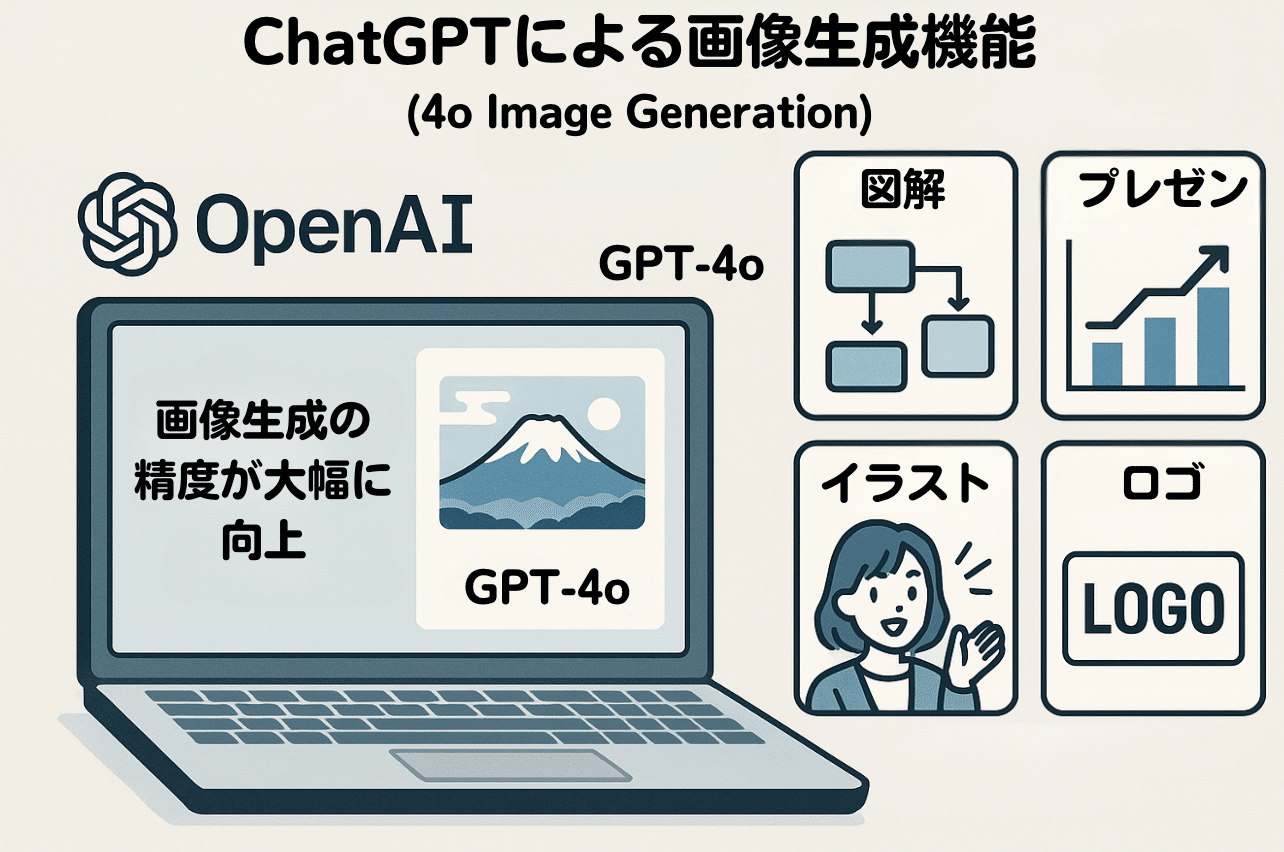
ChatGPT's image generation capabilities reached a major turning point in March 2025. Replacing the previous DALL·E 3 system, OpenAI natively implemented image generation directly into the GPT-4o model itself [1].
Notably, the rendering accuracy for images containing Japanese text has improved significantly, making it much easier to create practical, detailed visuals such as explanatory diagrams, presentation graphics, manga-style illustrations, and logo designs.
In university education, this technology holds promise for instructors who need to quickly prepare figures tailored to lecture content, and for students creating their own visual elements for reports and presentations. However, the fact that anyone can now easily generate high-quality images also underscores the need for renewed awareness of copyright and ethical issues.
Distinguishing between "expression" and "idea"
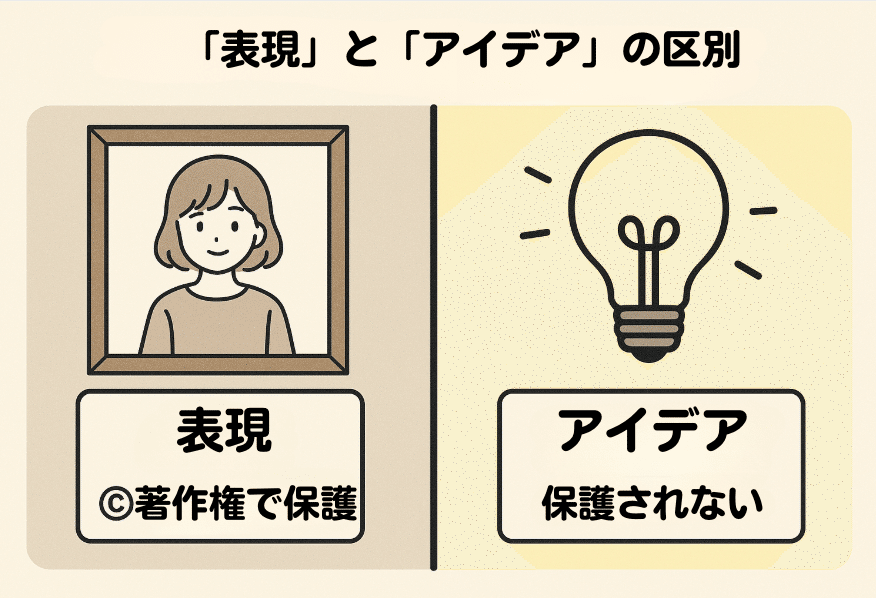
Under Japanese copyright law, protection is limited to works in which "thoughts or sentiments are creatively expressed"—that is, to concrete expressions. Ideas themselves are not protected (Copyright Act, Article 2, Paragraph 1, Item 1).
Based on this principle, artistic style and manner are categorized as ideas, and imitating them is not interpreted as an immediate copyright infringement. The Agency for Cultural Affairs has also stated the view that images generated using prompts specifying a "particular artist's style" do not automatically constitute copyright infringement. Images obtained by instructing generative AI to adopt a specific style tend to be regarded not as reproductions of existing copyrighted works, but basically as expressions of new ideas. [2]
That said, not all outputs from generative AI can be used freely. One must pay close attention to whether the concrete expression resembles an existing copyrighted work. If an AI-generated image closely resembles a specific existing work, using that output may be judged to infringe upon the reproduction rights or adaptation rights of the original work, even if the prompt merely specified "in the style of X".
In determining copyright infringement under Japanese law, "similarity to an existing work" and "reliance" on that work (accessibility) are critical factors. Because generative AI is trained on vast amounts of data from existing works, it is hard to deny the possibility that a generated result relies on copyrighted works in the training data; if similarity is high, the output risks not being recognized as an independent creation. Moreover, under current legal interpretation, even when it is highly likely that the generative AI tool used was not trained on data from the existing work, reliance is presumed if a high degree of similarity is recognized (see the Boiled Bean Seller case [Nimame-uri case]). Therefore, when publishing or using a generated image, one must carefully assess whether it can be called an original creative expression clearly distinct from any existing work. [3]
Furthermore, in extreme situations that unreasonably prejudice the interests of the copyright holder, exception clauses to rights limitation provisions may apply, and the use could be judged illegal even if similarity and reliance are not pronounced. [4]
Students must fully understand this point when using generative AI in educational settings. It is important for instructors to discuss with students what kind of social reactions and legal evaluations might result from casually publishing works that simply imitate a famous artist's style, and to provide appropriate guidance.
(Note: Educational use exceptions)
When using generative AI at universities and other educational institutions, it is necessary to keep both legal risk management and ethical perspectives in mind. From the standpoint of copyright compliance, an accurate understanding of the exception for educational purposes (Article 35 of the Copyright Act) is required. Article 35 is a general exception governing the use of copyrighted works in educational institutions. This provision is not specific to image-generating AI; it stipulates that instructors and students may reproduce or publicly transmit copyrighted works to the extent necessary for use in the course of lessons at schools and other educational institutions. However, this permission is strictly limited to use within the narrow context of a class.
Consequently, even if an image created by a student or instructor using generative AI happens to resemble an existing copyrighted work, its use is permitted under Article 35 so long as it remains within the scope of a lesson, provided it does not unreasonably prejudice the interests of the copyright holder. However, if that generated work is distributed outside of class or published on the internet, this educational use exception does not apply. Therefore, even when using AI-generated outputs as course materials, it is prudent to check in advance for similarities to specific works and avoid any use that goes beyond the scope of the class.
Ethical considerations
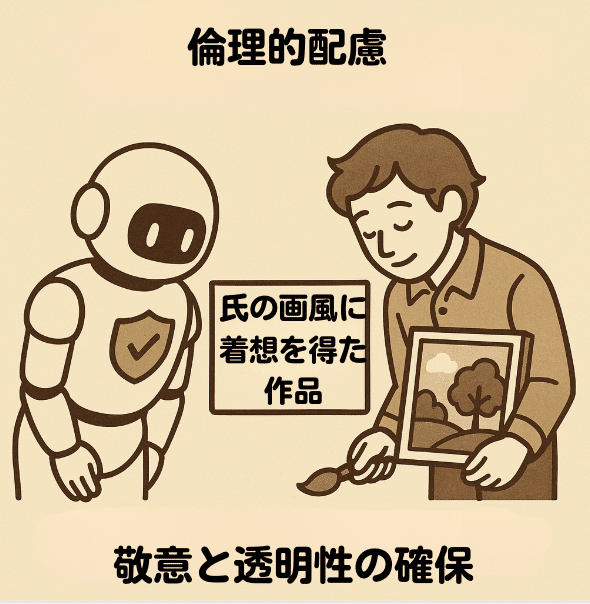
All acts of creation and expression—not just those involving image-generating AI—carry socially expected ethical responsibilities. Key ethical considerations include respect for creators and ensuring transparency. Even where there is no legal issue, when generating and publishing images that imitate the style of a specific individual artist, it is desirable to consider the feelings of that artist and the relevant community. For example, disclosing sources and reference information—such as explicitly stating in the work's description that it is "an original work inspired by the style of X," or specifically naming reference works when citation is possible—is a practice that aligns with research ethics.
Furthermore, it is important to ensure that the content of a work does not promote discrimination or prejudice regarding race, gender, or other attributes, does not offend public order and morals, and does not unjustly infringe upon the moral rights or privacy of others. Understanding that creative freedom comes with responsibility, eliminating discriminatory expressions, and upholding appropriate information morals are attitudes always required regardless of whether generative AI is involved. While these are not direct copyright issues, they are indispensable perspectives for educational institutions seeking to cultivate individuals capable of using AI responsibly in society. [5]
In summary, in university education settings, stakeholders must work together to establish and revise guidelines while making use of the benefits of generative AI and properly understanding the permissible scope and limitations under copyright law. Because legal interpretations and social consensus may shift as technology advances, it is necessary to closely monitor the latest trends and practice AI utilization that respects both copyright and ethics.
References
Introducing 4o Image Generation. Accessed March 30, 2025. https://openai.com/index/introducing-4o-image-generation/
[AI copyright issues: Is the world created by AI "expression"? "Idea"? Or...] | shiba@Creative Management. note. September 8, 2023. Accessed March 30, 2025. https://note.com/48art/n/nbea41b5f0972
Do texts and images created with generative AI constitute copyright infringement? Points to keep in mind during use. Accessed March 30, 2025. https://www.docusign.com/ja-jp/blog/AI-Engineer-Explains-Copyright-for-Generative-AI-Content
Taichi Kakinuma. [Series] Generative AI and Copyright: Based on the "Approach" of the Legal System Subcommittee of the Copyright Subdivision of the Council for Cultural Affairs, Part 2 | For legal consultation on intellectual property, IT, artificial intelligence, and venture business [STORIA Law Office]. STORIA Law Office. April 11, 2024. Accessed March 30, 2025. https://storialaw.jp/blog/10782
Handling of generative AI in educational aspects at universities and colleges of technology: Ministry of Education, Culture, Sports, Science and Technology (MEXT). MEXT Website. Accessed March 30, 2025. https://www.mext.go.jp/b_menu/houdou/2023/mext_01260.html
(Note on the images in this article)
The images in this article were generated using 4o-Image-Generation based on the article's content, and then partially modified using the graphic design tool Canva.
Related
 What healthcare professionals should know first when using generative AIshoei05.com